Parts, serial numbers and lead times on a built-in
That a model name is enough to order a part, and that every repair either happens on the first visit or does not happen at all.
Monday to Friday 8:00am – 6:00pm · Saturday 9:00am – 4:00pm
(904) 478-8963The oven heats but never produces steam, or the cycle stops early
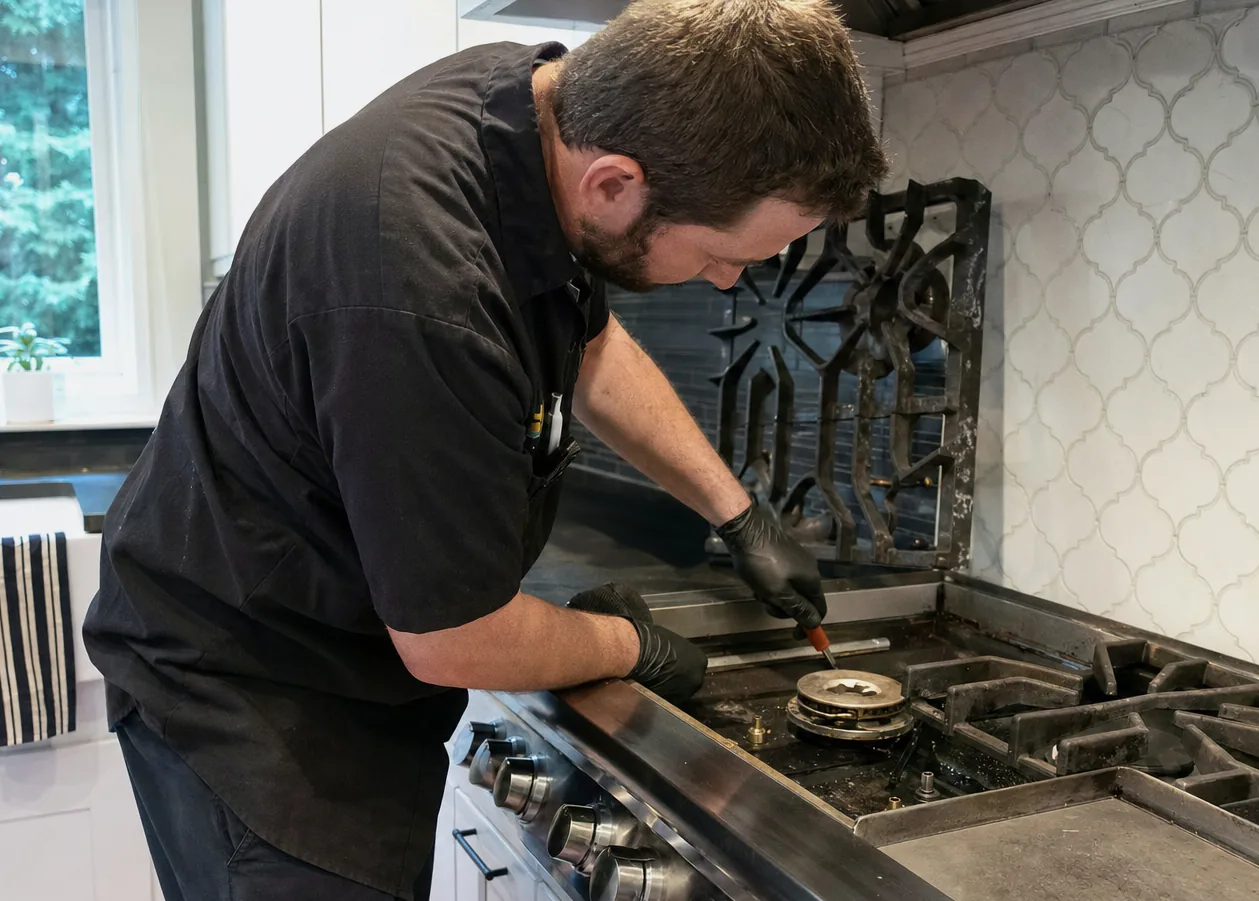
Causes are listed as symptoms and mechanisms, not part numbers. The actual fault is confirmed on site.
Start at the tank
Prove that the appliance is drawing at all before anything else gets opened.
A steam oven that will not steam has failed at one of four places: water is not arriving, water is arriving and not being heated, the cavity cannot hold what is produced, or the control is not asking for any of it. The sequence below separates those four in about fifteen minutes.
A steam generator needs water to arrive before anything else matters. Check whether the reservoir is fully seated — a tank that sits a few millimetres proud will read as present and still not feed. Look at whether the reservoir level drops at all during a cycle. If the level never moves, nothing downstream of the tank is worth investigating yet.
If the level does drop but no steam appears, the water is going somewhere it should not, or it is arriving and not being heated. Look for water in the base of the cavity at the end of a failed cycle. Water present means delivery is working and the generator is not heating. A dry cavity after a cycle that drew water means it went somewhere it should not have.
A steam cavity has to hold pressure and humidity, and it cannot do that through a seal that no longer meets the frame. Run a strip of paper around the closed door and pull. Anywhere it slides out with no resistance is a path for steam to escape, and an appliance venting continuously will read as one that never produced steam in the first place.
Latches matter too. A door that closes and latches but does not pull square along its whole run gives the same result as a failed gasket. On kitchens where the appliance has been in service since the house was built, relaxed hinge springs are a routine finding rather than an unusual one.
Ask when it last worked and what happened in between. A failure that dates from a storm week points at the control board rather than the water path. Momentary outages are common here and they are hard on electronics that were mid-cycle. Clay County averages roughly 68 thunderstorm days a year, so this is not an unusual coincidence — it is the single most common origin story for a built-in that stopped completing cycles.
The other electrical possibility is a thermal fuse. These open after the appliance has run restricted for a period, and once open they stay open. The picture is an oven that behaves entirely normally, accepts a steam program, draws water, and produces no heat at the generator. It is not a fault the owner can reset.
The state of the cavity after a failed program is evidence, and it is free.
Standing water in the base with no steam produced means delivery worked and the generator did not heat — that points at the generator circuit, its thermal fuse, or the control asking for heat. A completely dry cavity after a cycle that drew water from the tank means the water went somewhere it should not have, which is a leak in the fill path rather than a heating fault. A tank whose level never moved at all means the appliance never drew, and nothing beyond the tank, the valve and the pump is worth considering yet.
Note the sound as well. A pump that runs for its normal duration and delivers nothing behaves differently from one that never energises, and an owner who can say which of those happened has already halved the search.
The $80 diagnostic covers finding the actual fault rather than guessing at it: verifying that water is drawn and delivered, checking the generator circuit for continuity, confirming whether a thermal fuse has opened, and reading how the control responds. You get a written estimate before any work begins, and the diagnostic is credited toward the repair.
If the appliance is tripping a breaker, smells hot, or leaves standing water in the cabinet, stop running it and book. Everything else on this list can wait for a scheduled appointment.
$80 covers the diagnosis, and it is taken off the total if you decide to go ahead. Past that the figure is set by which component has actually failed, and the rows below are where a steam oven repair has been settling. Nobody here quotes one number before the panel is off.
| What has failed | Parts and labor |
|---|---|
| Diagnostic visit | $80 flat |
| Control board or touch panel | $440–$1,010 |
| Door hinge, glass or seal | $180–$680 |
| Oven thermostat or temperature sensor | $180–$560 |
Ranges, not quotes. The width of a band is mostly access: a component reached from the front is one job, and the same component behind an appliance that has to come out of its opening is quite another. How a job is priced.
That a model name is enough to order a part, and that every repair either happens on the first visit or does not happen at all.
That a repair is priced by the size or the age of the appliance, rather than by which single component inside it has actually failed.
That an appliance failing the week after a storm is a coincidence, and that surviving the outage without visible damage means the electronics are fine.
That appliance maintenance is mostly about cleaning cycles and additives, rather than about airflow, filtration and seals.
That there is nothing useful an owner can do before a service visit except wait, and that a code on the display is the whole story.
That calling an independent technician or fitting a non-Thermador part cancels the warranty, when Thermador's own range statement says neither one voids it.
That a built-in appliance can be judged by the same replace-it-cheaply arithmetic as a freestanding machine.
Rated 4.5 out of 5 across 72 customer reviews. Read all 72.
Our steam output had faded over a couple of years until there was almost none. He descaled the generator properly with it out of the wall and showed me the deposit he had taken out. It is like new again.
Rosalyn D.June 2026
The reservoir drained but nothing arrived in the cavity. A blocked feed had the pump running dry. He flushed the line and it works, though he needed a second trip because the pump had been damaged by then.
Cyrus O.July 2026
No steam at all, though the oven heated normally. He found the generator element crusted over and cleaned the collar by hand, explaining that a chemical cycle cannot reach it. It steams from the start again now.
Winifred K.August 2026
Flat $80 diagnostic, credited toward the repair. Written estimate before any work begins. Serving Clay County.
Call (904) 478-8963