Thermador steam oven not making steam
The oven heats but never produces steam, or the cycle stops early
Monday to Friday 8:00am – 6:00pm · Saturday 9:00am – 4:00pm
(904) 478-8963Corrects That a repair is priced by the size or the age of the appliance, rather than by which single component inside it has actually failed.
One component, not one appliance
What a built-in repair costs is set by which part failed — not by how large or how old the appliance is.
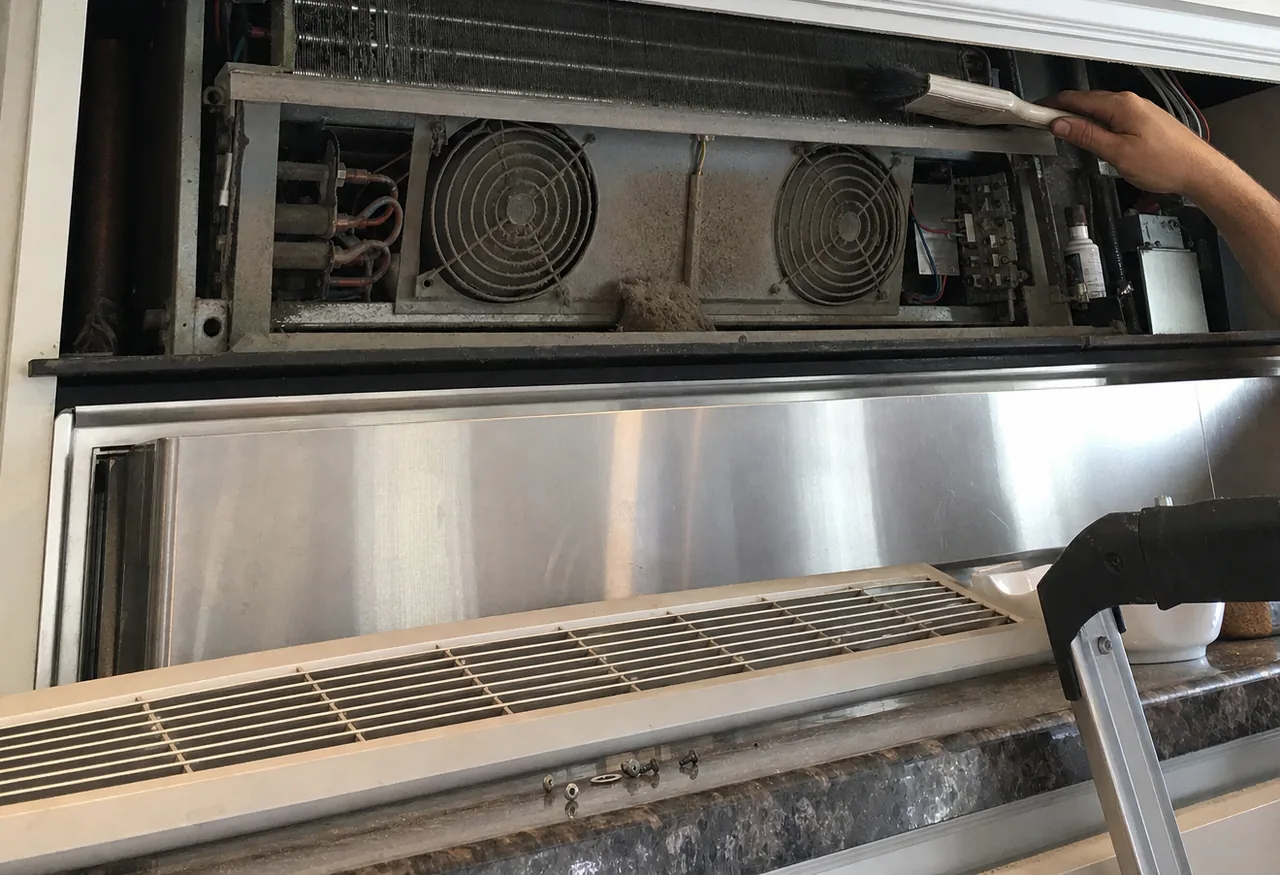
Almost every first call arrives with the price question phrased the wrong way round: what does it cost to fix a wall oven, what does it cost to fix a column. The appliance is not what sets the figure. One component inside it is, and the spread between the cheapest of those components and the dearest is wide enough that no honest single number exists. Read the table on this page from the top down and the whole logic of it comes apart neatly.
On a refrigeration column the sealed system is the compressor, the evaporator and the refrigerant circuit that joins them. It heads the table for three reasons that have nothing to do with anybody’s hourly rate.
It is closed. Opening it, recovering what is in it and recharging it correctly is a different class of work from swapping a component in free air, and it requires EPA Section 608 handling — a federal technician credential, held here, and nothing to do with any manufacturer’s program. It is slow, because a column usually has to come out of its opening to be worked on and go back into it square. And the components themselves are specific to the build, so there is rarely a shortcut through a generic equivalent.
What it is not is an automatic reason to replace the appliance. Set that band against the replacement table further down: the column has to come out either way, the opening and the panel still have to be satisfied, and one of those two paths ends with an appliance that fits.
Boards and touch panels sit just below the sealed system, and they are the row most likely to turn up on an appliance of any kind — an oven, a dishwasher, a coffee system, a hood. A board is a board.
They are also the row this county generates more of than most. Clay County averages roughly 68 thunderstorm days a year, and the multi-day outages that came with Matthew in 2016, Irma in 2017 and Helene in 2024 each produced a run of board failures that did not show up on the day the power came back, but weeks later. If the appliance stopped behaving the same season the supply did something unusual, say so when you book. It changes the order things get checked in and it changes what is likely to be ordered.
Convection motors, hinge sets, door glass and seals, thermostats, sensors, bake and broil elements, igniters and spark modules occupy the middle and lower rows. They are the bulk of the work. Most are a single part with a confirmed test behind it, most are fitted from the front of the appliance, and most land nearer the bottom of their band than the top.
That is the part of this trade that gets talked about least, because a straightforward repair makes no story. It is also the reason the repair-or-replace question usually resolves in favour of the repair.
The band is set by the component. Where in the band a particular job lands is set by three things, in roughly this order.
Access first. A part reached from the front is one job; the same part behind an appliance that has to be drawn out of a finished opening, over a finished floor, with an anti-tip fixing released and a panel removed, is another.
Supply second. A current component is straightforward. A serial-specific one, or one superseded into a longer lead time, changes what the estimate can promise and sometimes changes the answer entirely.
Geometry third. If the cutout, the circuit or the duct around the appliance is part of the fault, putting that right is work the appliance did not cause and cannot be repaired out of.
The flat diagnostic exists to put the job in the right row before anything is ordered. That means reading components electrically rather than by appearance, checking sensors against their expected values, watching how the control answers a call for heat or cold, and confirming the supply is actually present at the appliance. It ends in a written estimate that names the part, the labor and the expected wait.
A part ordered before the fault is confirmed is a part ordered twice, and on a built-in the second order is rarely the cheap one.
$80 covers the diagnosis, and it is taken off the total if you decide to go ahead. Past that the figure is set by which component has actually failed, and the rows below are where the work this page describes has been settling. Nobody here quotes one number before the panel is off.
| What has failed | Parts and labor |
|---|---|
| Diagnostic visit | $80 flat |
| Igniter, spark module or surface element | $210–$490 |
| Oven thermostat or temperature sensor | $180–$560 |
| Bake or broil element | $210–$580 |
| Convection fan or motor | $260–$670 |
| Control board or touch panel | $440–$1,010 |
| Door hinge, glass or seal | $180–$680 |
| Refrigeration column sealed system | $920–$2,400 |
A comparable Thermador wall oven, rangetop or column, appliance only — before delivery, installation or cabinetry. National appliance pricing, not Florida labour.
| New appliance | Appliance only |
|---|---|
| Wall oven, the usual repair-or-replace comparison | $4,200–$9,500 |
| Professional rangetop or range | $5,500–$14,500 |
Ranges, not quotes. The width of a band is mostly access: a component reached from the front is one job, and the same component behind an appliance that has to come out of its opening is quite another. How a job is priced.
The oven heats but never produces steam, or the cycle stops early
The oven is not heating up: it preheats slowly, runs cool, or never reaches the set temperature
A zone beeps, flashes and shuts off, or will not detect the pan at all
The column runs but is not cooling: the cabinet drifts warm, or one section cools while the other does not
The dishwasher is not draining: water is standing in the bottom of the tub at the end of the cycle
The igniter clicks continuously but the burner will not light, or lights then goes out
That a model name is enough to order a part, and that every repair either happens on the first visit or does not happen at all.
That calling an independent technician or fitting a non-Thermador part cancels the warranty, when Thermador's own range statement says neither one voids it.
That a gas burner which glows or clicks without lighting always needs a new igniter, when a damp tip, a crooked cap or a tripped breaker gives the same symptom.
A diagnostic beats a guess. Scheduled appointments across Clay County.
Call (904) 478-8963