Skip to content

Monday to Friday 8:00am – 6:00pm · Saturday 9:00am – 4:00pm

(904) 478-8963
Before you call

What it costs, and the rest

Most first calls open with a money question. Those are answered first here, from the same band table the estimate is written off, then the rest.
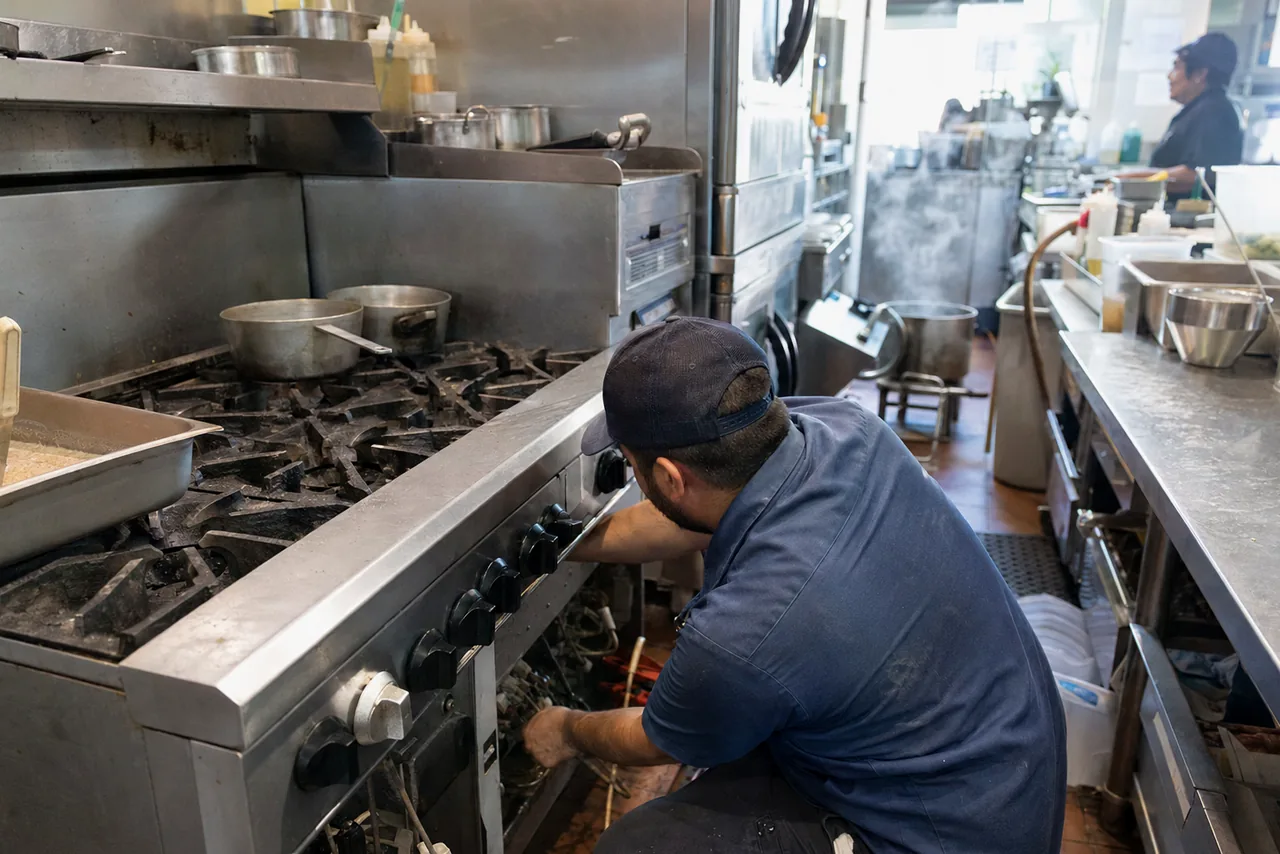
A technician kneeling at the front of a stainless gas range with the fascia off, the burner tops loaded and a colleague working further down the line
Most questions are really one question: what has to come out first.

What it costs, and whether it is worth it

Is it worth repairing a built-in Thermador, or replacing it?
Set the band the confirmed fault sits in against a replacement. The cheapest rows here start at $180, while a comparable wall oven is $4,200–$9,500 for the appliance alone, before installation. One component on an otherwise sound built-in is rarely a close call. A refrigeration column sealed system at $920–$2,400 is.
What is the 50% rule, and does it hold on a built-in?
The rule says replace once the repair passes half the price of a new appliance. On a built-in it flatters replacement, because the $4,200–$14,500 quoted here is the appliance only: delivery, installation, an altered cutout and a panel made for the old door all sit on top of it and never enter the rule.
How much do appliance repair technicians charge per hour?
Nothing per hour here. A flat $80 diagnostic covers the visit and the whole fault-finding sequence, credited to the repair if you go ahead, and the work itself is quoted as one figure from the band the confirmed fault sits in. A slow job and a quick one in the same band cost the same.
What does the $80 diagnostic actually cover?
The visit and the fault-finding: reading components electrically, checking sensors against their expected values, watching how the control answers a call for heat or cold, and confirming supply at the appliance. It ends in a written estimate naming the part, the labor and the wait. $80 whatever the answer is, credited if you go ahead.
What pushes a quote to the top of its band?
Access, mostly. A component reached from the front is one job; the same component behind an appliance that has to come out of its opening is another. Then part supply — a serial-specific or long-superseded component — and whether the cutout, the circuit or the duct around the appliance has to be put right as well.
What is the most expensive part to replace?
The refrigeration column sealed system at $920–$2,400, and on refrigeration that work also needs EPA Section 608 handling. Behind it comes the control board or touch panel at $440–$1,010, the row that can turn up on almost any appliance in the kitchen. Everything else in the table sits below both.
Is it worth replacing the compressor in a refrigeration column?
Usually, and it is not close: the refrigeration column sealed system runs $920–$2,400 against $4,200–$14,500 for a replacement that still has to fit the existing opening and carry the same panel. It stops being obvious once the column has already had two major components, because that is a pattern rather than bad luck.
How long should a built-in Thermador appliance last?
The trade generally reckons built-in equipment of this class well past a decade, and often nearer two, because it is built to be repaired rather than replaced. We publish no figure of our own. What decides it here is power events, heat and installation geometry — not the badge on the door.

Scope, warranty and paperwork

What does a service visit cost?
A flat $80 diagnostic covers the visit and the fault-finding. It is credited toward the repair if you go ahead. You get a written estimate before any work starts, so nothing is open-ended.
Are you a factory service center?
No. Clayfield Appliance Service is an independent appliance repair company, and working on one manufacturer was our own decision rather than an appointment by anyone. We service Thermador appliances and nothing else, and we fit genuine OEM parts. The full independence statement is in the footer of every page.
Do you work on heating or air conditioning?
No. This is a built-in kitchen practice: wall and steam ovens, ranges and rangetops, refrigeration columns, dishwashers, coffee systems and the extraction hood over the cooking surface. Furnaces, air handlers, heat pumps, mini-splits and the ductwork that serves the rest of the house are a separate licensed trade, and they get referred rather than attempted. The hood's own duct out through the roof is the one exception, because it belongs to the appliance.
What warranty comes with the repair?
Ninety days on labor and three hundred and sixty-five days on the parts we supply. Parts are genuine OEM, which is what keeps the parts warranty meaningful on a built-in appliance.
Do you work on other brands?
No. This is a Thermador-only practice. Staying on one manufacturer is why the parts inventory, the service literature and the diagnostic habits are worth anything on a built-in appliance.

Booking, parts and the visit

What should I have ready when I book?
The serial number, photographed off the plate rather than transcribed, and a description of what the appliance actually does rather than what you think has failed. Say whether anything was installed, renovated or storm-affected shortly before the fault appeared. Those three things decide where the diagnostic starts.
Is an older built-in still worth repairing?
Usually, because most faults on this equipment are one component and the appliance is already sized, panelled and wired into the kitchen. The exceptions are a part superseded out of supply and a sealed-system failure late in an appliance's life, and where that is the case the written estimate says so before any work begins.
How long does a part take to arrive?
Components for current appliances and the generation behind them generally move quickly. Long-superseded parts and low-volume assemblies do not, and the expected wait is written into the estimate on the day rather than reported back a fortnight later.
The short version

Independent, one brand

Thermador built-ins only, genuine OEM parts, and a written estimate before any work begins.

What does the visit cost, in numbers?

$80 covers the diagnosis, and it is taken off the total if you decide to go ahead. Past that the figure is set by which component has actually failed, and the rows below are where this work has been settling. Nobody here quotes one number before the panel is off.

Every band this workshop quotes from, parts and labor together.
What has failed Parts and labor
Diagnostic visit $80 flat
Igniter, spark module or surface element $210–$490
Oven thermostat or temperature sensor $180–$560
Bake or broil element $210–$580
Convection fan or motor $260–$670
Control board or touch panel $440–$1,010
Door hinge, glass or seal $180–$680
Refrigeration column sealed system $920–$2,400

Ranges, not quotes. The width of a band is mostly access: a component reached from the front is one job, and the same component behind an appliance that has to come out of its opening is quite another. How a job is priced.

Longer answers

Parts · 6 min

The parts that decide the price

That a repair is priced by the size or the age of the appliance, rather than by which single component inside it has actually failed.

Still not answered?

Ask on the phone. Describing what the appliance does when you start it is worth more than any page here.

Call (904) 478-8963